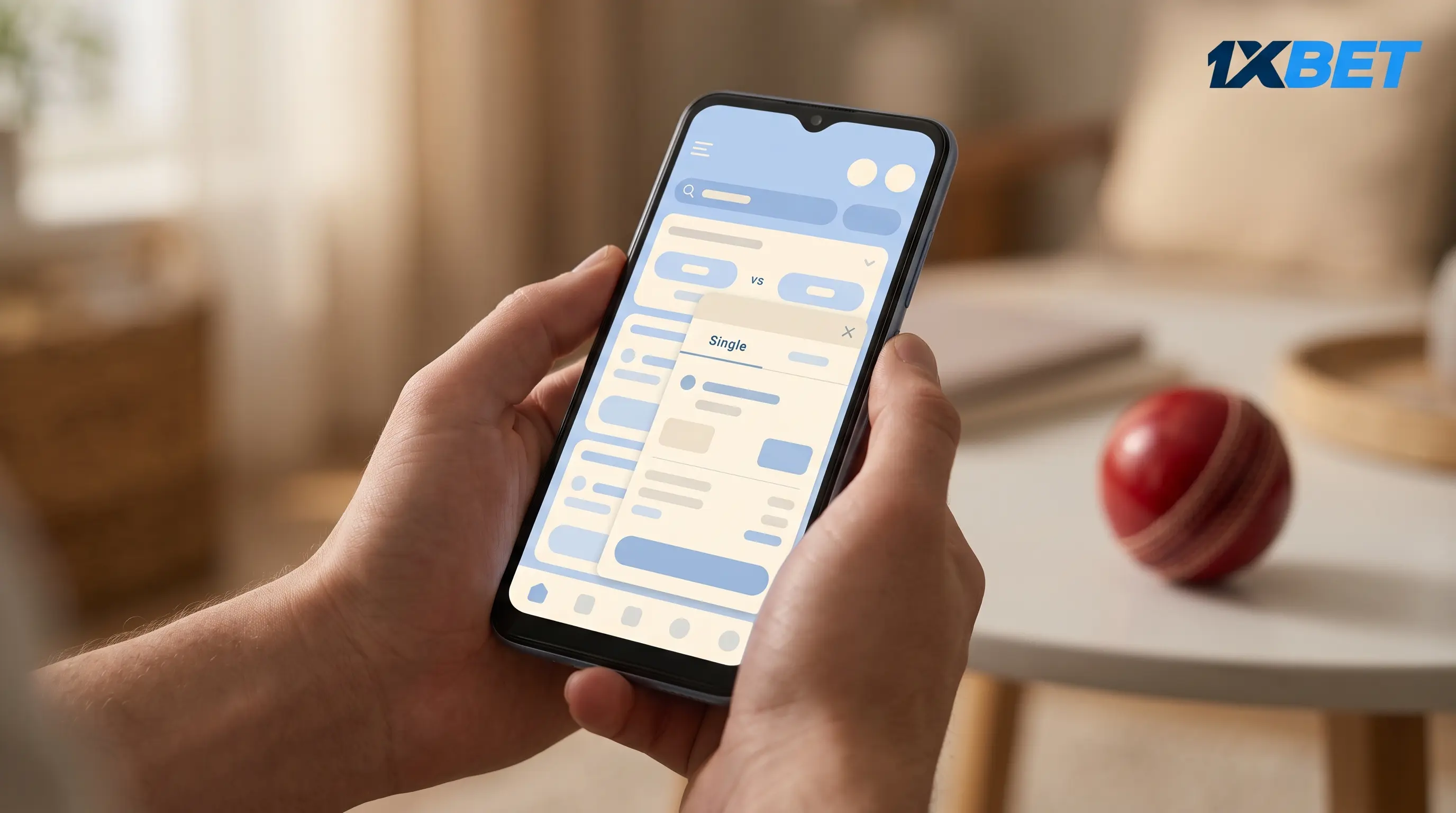
How to Bet on Cricket in 1xBet: A Beginner's Guide to Bet Types and Your First Slip
Last verified: October 2026
To bet on cricket at 1xBet you pick a match, pick a market, enter your stake in the bet slip and click confirm. It's all very simple and works just as well on a basic Android phone. Below we go through the main types of cricket bets, walk you through your first bet slip step by step, show you how odds turn into a payout and explain the eight terms you'll see most often.
Cricket Bet Types Explained From Scratch
The vast majority of cricket betting is split into three broad categories: markets on the match result, markets on the individual players and markets on what happens in the match.
- Match Winner. You choose which team wins the match. For instance you'd back Pakistan to beat Sri Lanka in a T20 international and your bet would win if Pakistan did in fact take the result.
- Toss Winner. You select which captain wins the coin toss at the start of the match. For instance you could pick that the Pakistan captain calls it correctly. It's decided prior to the first ball being bowled.
- Top Batter. You pick the player who scores the most runs (either for one side or in the whole match). For instance you'd pick which Pakistan opener is going to top score against Sri Lanka.
- Top Bowler. You pick the bowler who takes the most wickets for a team or in the match. So for instance you'd pick which Pakistan bowler finishes with the best figures.
- Total Runs Over/Under. The bookmaker sets the line and you're betting on whether the runs will be over or under that line. So if you're betting on Pakistan's innings you'd be deciding whether it will be over or under the line.
- Player of the Match. You select the player who is to receive the official award at the end of the game. For instance you might select a Pakistani batter or a Pakistani bowler that you think is going to be the player who dictates the game.
- Series or Tournament Winner. You pick the team that wins the whole series/competition. So you'd pick a team to win the Pakistan Super League for instance and your stake would remain open right through until the final is played.
If you're just getting into it, start with Match Winner as it's by far the easiest market to get your head around and follow.
How to Place Your First Cricket Bet on 1xBet
- Open Sports, then Cricket. From the main menu select Sports and then Cricket from the list.
- Pick a tournament and a match. Pick a competition and then tap the match that you want to bet on.
- Tap the odds on a market. If you tap the odds (for instance next to a team name in Match Winner) that selection will be added to your bet slip.
- Check that Single is selected. Single is one selection and one bet, the simplest way to get going.
- Enter your stake. Put in the amount in PKR (we'll use PKR 500 as an example).
- Review the potential return. The slip will tell you exactly how much you'd get if the bet wins so check it before you go on.
- Tap Place Bet. If the odds have changed whilst you've been reading the slip it may well ask you to accept the new price first as the odds will move as the game progresses and the betting market changes.
- Find your bet in Bet History. Open your Bet History to see the bet, the stake and the status of it once the match has been settled.
Once you've placed your first bet you can then follow the match and view the result in the same bet history.
What Cricket Odds Mean for Your Payout
On 1xBet the odds are given in decimal format and decimal odds x your stake will give you your total return.
Here's the working for two bets each with a stake of PKR 500. At 1.85 you'd simply multiply 500 by 1.85 to get 925. That's your total return (includes your stake back) so your profit is 425. At 3.20 you'd multiply 500 by 3.20 to get 1,600. Your profit is 1,100 as you've got to take off the original 500 you staked. Profit is always total return less your stake.
PKR 500 | 1.85 | PKR 925 | PKR 425 |
PKR 500 | 3.20 | PKR 1,600 | PKR 1,100 |
Lower odds mean the market regards that outcome as more likely, hence the return is smaller. Higher odds work the other way round. These are the returns if the bet wins, if it loses you simply lose your stake.
Cricket Betting Glossary: 8 Terms You Will See
These terms dictate how your bets are settled so it's worth knowing them prior to you lay a stake.
Void | A bet that is cancelled and your stake is returned, usually because a match or market cannot be settled normally. |
No Result | A match ends without a winner, often because of rain. Many markets are then voided, but the exact rule depends on the market. |
DLS method | A formula that resets the target score when rain cuts an innings short. It can change which team wins and how bets settle. |
Super Over | A one-over-per-side tiebreaker played when scores finish level. Check whether your market counts the Super Over or only the regular match. |
Dead Heat | When two or more selections tie, for example two players with the same top score. Your winnings are usually divided, not paid in full. |
Powerplay | The first overs of an innings with fielding restrictions. Some markets, such as runs in the Powerplay, are settled only on that period. |
Innings runs | The total runs one team scores in its innings. Over/under bets on innings runs are decided by that team's total alone. |
Handicap (runs) | A head start given in runs to the weaker side. You win if your team, after the adjustment, finishes ahead. |
Four Mistakes New Cricket Bettors Make
- Betting on your own team by default. Support isn't a reason to bet on so you need to ask yourself whether the odds are actually reflecting the team's true chances. If they aren't then don't bet on the match, or at least don't bet on that market.
- Build your long accumulators too early. Every additional selection is another opportunity for the whole thing to go wrong and one leg to go wrong and it's all up. Start with single bets until you understand how the markets and the odds work.
- Pursuing losses after a collapse. A sudden batting collapse will of course tempt you to go in and put down a bigger stake straight away in the hope of getting the money back. Keep your stake the same and if you're feeling frustrated just walk away from the game.
- Ignore the toss and the weather news. Rain, a late start or the toss outcome can all have an impact on how a match plays and how your bet is settled. Always check the team news, the toss and the weather forecast prior to confirming your stake.
FAQ
Can I bet on cricket at 1xBet with a small stake?
Yes you can usually bet a small amount on cricket though the minimum stake will vary from market to market and will of course be subject to change over time. Check your bet slip after you've added your selection as that's where it will tell you whether your stake has been accepted prior to you confirm. Start small as you get to grips with how the markets work.
What's the easiest cricket bet for a beginner?
The easiest cricket bet for the novice is Match Winner - you're just picking which team you think will win. There's only one selection to make, the outcome is straightforward and you don't need to worry about individual players or runs. Once you're confident in that, you can move on to the other markets.
What happens to my bet if the rain stops the match?
It varies depending on the market you're betting on. If rain stops a match and it ends up with no result then most bets on that match will be void and your stake will be returned. Some markets however work differently so you need to always check the rules for your particular market prior to placing a bet.
Do I need to understand the odds before I start betting?
No, but knowing the odds is useful in that it tells you what a bet could return and gives you an idea of how likely the market thinks an outcome is. Decimal odds x your stake gives you your total return and the lower the odds the more likely the outcome is. That's all you need to make your first bet.
Bet Responsibly
Betting is for adults of legal age only. Set a budget prior to the match and stick to it. Never chase losses with bigger bets. Betting should never be a means of making money so any stake should be treated as the price of entertainment. Take regular breaks during long live sessions. If it stops being fun, stop. Talk to someone you trust and use the self-limit or self-exclusion tools in your account.